
The car ride from Tampines to the dojo takes fifteen minutes, but Dilan feels every second of it. He sits in the back seat, his towel folded across his lap, his fingers picking at a loose thread near the hem. The tablet is at home, lying on his bed where he left it. He had almost reached for it on the way out the door, the blue shark case catching the morning light, but his mother had called his name from the lift lobby and his hand had dropped to his side.
Now he watches the HDB blocks slide past the window, one after another, identical and sun-bleached. His father drives with both hands on the wheel, not speaking. His mother hums something tuneless from the passenger seat, scrolling through her phone. The car smells of the lemon-scented tissue box clipped to the air-con vent.
“Sensei Lim is very experienced,” his mother says, twisting around to look at him. Her fingers leave a faint smudge of ink on the seat back. Dilan notices it before he meets her eyes. “Your father read about the dojo online. Very good reviews.”
“Okay,” Dilan says.
“It’s not a competition, Dilan. Nobody’s keeping score.”
“Okay.”
He does not know what else to say. The word feels small and flat in his mouth, but it is all he has. His father glances at him in the rear-view mirror, a quick flick of the eyes, and then returns his attention to the road.
The dojo sits on the second floor of a low building near the Tampines Round Market. A sign above the stairwell reads SHOTOKAN KARATE in block letters, the paint faded at the edges. Dilan follows his parents up the stairs, his sneakers squeaking on the concrete steps. The sound echoes in the narrow space, too loud, and he tries to step more softly.
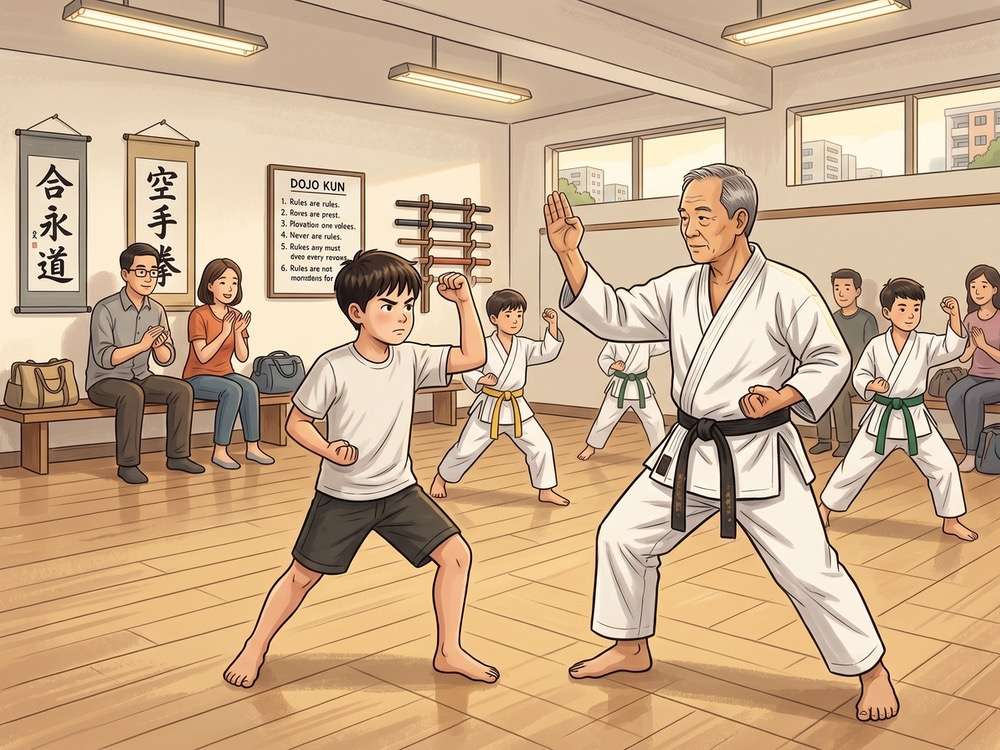
At the top, his father slides open a frosted glass door. The smell hits Dilan first. Polished wood and something sharper underneath, a scent he does not have a name for. Sweat, maybe. Effort. The floor is made of long wooden planks, pale and gleaming under the fluorescent lights. A row of children stands near the far wall, barefoot, their feet spaced apart in a stance Dilan does not recognize. They wear white uniforms tied with colored belts. Some of the belts are yellow, a few are orange. One girl near the end has a green belt and her ponytail swings as she shifts her weight.
Dilan’s mother squeezes his shoulder. “We’ll be right here,” she says, nodding toward a low bench along the side wall. His father is already settling onto it, folding his hands in his lap with the same deliberate movement he uses when he sits down to review his architectural drawings.
A man steps forward from the front of the room. He is not tall, but he stands with a straightness that makes him seem larger. His uniform is crisp and white, his black belt knotted at the waist. His face is lined, calm, and his gaze moves across the new students without lingering on any one of them.
“I am Sensei Lim,” he says. His voice is quiet but it fills the room. “You will remove your shoes and line up here.” He gestures to a strip of tape on the floor.
Dilan toes off his sneakers and sets them beside his mother’s tote bag. The wood is cool under his feet, smoother than he expected. He joins the other newcomers, three boys and two girls, all of them looking as uncertain as he feels. One boy keeps cracking his knuckles. A girl with glasses pushes them up her nose three times in quick succession.
Sensei Lim demonstrates the first stance. “Feet shoulder-width apart. Left foot forward. Bend your knees. This is zenkutsu-dachi. Front stance.”
Dilan tries to copy him. His left foot slides too far forward. He corrects it, then realizes his right foot is pointing the wrong way. He adjusts it, and his knees lock straight. A warmth creeps up the back of his neck. The boy next to him, the one with the knuckles, settles into the stance as if he has done it before. The girl with the glasses is already steady, her knees bent at exactly the same angle as Sensei Lim’s.
“Again,” Sensei Lim says. “Find your center.”
Dilan shifts his weight. His ankle wobbles. He presses his toes into the wood and tries to feel what the sensei means by center. The word sounds like something from one of his games, a stat you level up, but here it is just his body and the floor and the quiet ache starting in his thighs.
They move to blocks. Sensei Lim raises one arm, forearm horizontal, and sweeps it outward. “Age-uke. Upper block.”
Dilan raises his arm. His elbow is too high, then too low. He watches the sensei’s movement and tries again, slower this time, tracing the arc. His arm cuts through the air and stops. Not quite right. He tries again. The motion becomes a rhythm. Raise, sweep, stop. Raise, sweep, stop. His breathing steadies. The warmth in his neck cools.
From the bench, his father offers a small nod. It is barely a movement, just a dip of the chin, but Dilan catches it. His mother cups her hands around her mouth and whispers, “Keep trying, champ!” Her voice is bright and a little too loud in the quiet dojo. The girl with the glasses glances over. Dilan feels his face heat up again, but he does not look away from Sensei Lim.
They practice kicks. Dilan lifts his right leg and his standing foot slides on the smooth wood. He stumbles, catches himself with one hand on the floor, and straightens up fast. The knuckle-cracking boy is watching him. Dilan sets his jaw and lifts his leg again. This time he presses down through the ball of his standing foot the way Sensei Lim demonstrated, gripping the floor with his toes. His leg holds. The kick is not high, and his form is messy, but he does not fall.
The hour passes in a rhythm of stances and blocks and kicks, repeated until Dilan’s muscles feel loose and warm. The fluorescent lights hum overhead. Someone’s foot squeaks against the wood. Sensei Lim’s voice cuts through the silence in short, precise instructions. Dilan stops thinking about how he looks. He stops thinking about the tablet on his bed, the timed events, the boys at school. There is only the next movement, and the next, and the way his body is learning something without his mind having to translate it first.
When Sensei Lim claps his hands and announces the end of the session, Dilan is breathing hard. His legs are tired in a way they have never been tired before, a deep, satisfied ache that feels earned. He bows with the other students, pressing his palms to his thighs, and the motion feels less awkward than he expected.
His parents meet him at the bench. His mother hands him a water bottle from her tote bag, and he drinks without stopping, the water cold and sharp in his throat. His father says nothing, but his hand rests on Dilan’s shoulder for a moment, warm and steady.
“How do you feel?” his mother asks.
Dilan lowers the bottle. He is sweaty and his feet are sore and there is a small splinter in his finger from when he caught himself on the floor. He thinks about the question. The answer is not simple. He feels wrung out and clumsy and, somewhere underneath all of that, quiet in a way that has nothing to do with screens.
“Okay,” he says. But this time the word does not feel small. It feels like something he chose.
Sensei Lim approaches as Dilan is pulling on his sneakers. The sensei’s face is unreadable, but his voice is not unkind. “You think too much,” he says. “Your body knows what to do. Let it.”
Dilan looks up at him, unsure how to respond. He nods once. Sensei Lim nods back and walks away, his bare feet silent on the polished wood.
On the way down the stairs, Dilan’s legs shake a little. He grips the railing and takes each step carefully. The afternoon light spills through the stairwell window, warm and golden, and somewhere outside a mynah bird is chattering. Dilan takes a deep, shaky breath and feels the air move all the way down into his lungs. He is ready for the next movement, whatever it is.