


There is something about mechanical watchmaking that a digital screen will never be able to replace. A classic watch is a material synthesis of art, science, and history. It’s fine craftsmanship and personal expression and has a tangible soul that speaks to painters, engineers, and aviators alike. You don’t need a bottomless wallet to appreciate horological mastery. There are many independent and boutique makers who make pieces of breathtaking depth and character. Farer has always stood out in this category, blending distinctive British design with classical Swiss watchmaking. The Farer Stratton II Moonphase is the perfect example of this ethos, bringing celestial observation down to a beautifully wearable scale.
Story & Origin of the Farer Brand
Exploration and discovery fuel Farer’s creative energy, marrying British styling with exacting Swiss production. If you may have noticed, the Farer brand often names its creations after pioneering explorers and scientists, and the Stratton line has an exceptionally distinguished namesake.
It is named for Frederick Stratton, a distinguished officer in the First World War, and a noted mathematician and astrophysicist. Born in Birmingham in 1881, Stratton built an illustrious academic path that led him to Caius College, Cambridge. During wartime service, he earned the Distinguished Service Order, received an OBE in 1929, and was mentioned in dispatches five times. In peacetime, he served as professor of astrophysics and director of the Solar Physics Observatory from 1928 to 1947. He also presided over the Royal Astronomical Society and received the Prix Jules Janssen from the Societe astronomique de France. Naming an astronomical moonphase timepiece after Stratton ties the mechanical object directly to a legacy of charting the night skies.
Comparing the Two Strattons
The original Stratton established itself as one of the best-selling watches in the history of the brand, largely due to its warm presence and balance. The Stratton II represents a thoughtful, refined return rather than an outright reinvention.
The defining distinction between the two iterations lies in the moonphase aperture itself. Where the original turned heads with its expansive lunar display, the Stratton II returns with an updated moon graphic filled with more detail. This new moonphase disc is produced in Switzerland by AJS Production through a specialized manufacturing technique. By using precision lasers to micro-etch multiple layers of paint and luminous material, the Swiss workshop renders a realistic moon less than six millimeters in diameter. The updated disk is gold-plated and treated with BGW9 Super-LumiNova for improved visibility in low light, with more depth, texture, and realistic shading than before. The rest of the piece refines the beloved palette of the original, pairing the upgraded celestial art with natural stone and tailored proportions.
A Canvas of Eisenkiesel Stone and Golden Tones
From an artistic viewpoint, the dial is a masterclass in organic texture. Farer crafts each Stratton II dial from a solid slice of black Eisenkiesel, a naturally occurring quartz. The German name translates literally to iron pebble, which explains the golden-brown mineral veining running across the deep black background. Because this semi-precious stone is mined, cut, and polished to a slim thickness of only one millimeter, no two dials will ever look identical. Every owner receives a one-of-a-kind miniature abstract composition.
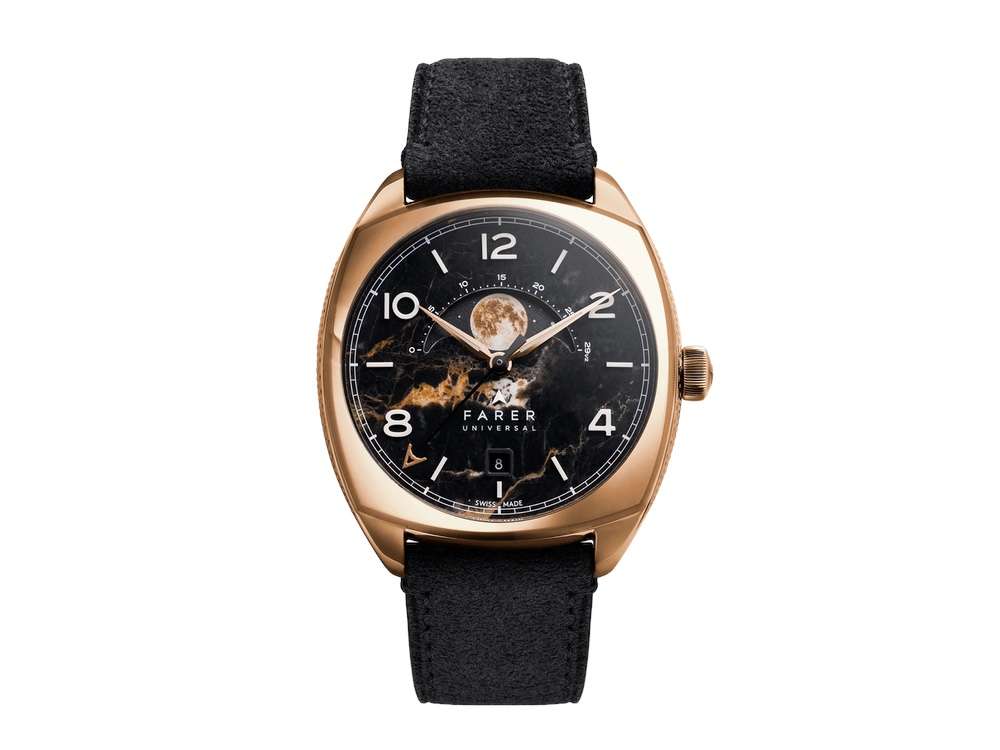
This natural pattern provides a canvas for the polished gold lance handset and the applied hour markers. The numerals and baton markers are cast from Lumicast, a high-tech fusion of ceramic and Grade X1 Super-LumiNova. This material ensures crisp structural relief in daylight and legibility in total darkness. A clean white minute track frames the perimeter, while the sweep seconds hand is finished with a gold Farer insignia.
Elegant Proportions Built for Slimmer Wrists
Many complicated moonphase timepieces suffer from excessive bulk, but the Stratton II takes an understated approach. Its 316L marine-grade stainless steel cushion case measures 38.5mm across and 11.5mm in thickness. On slimmer wrists like mine, the watch drapes naturally, with a compact lug-to-lug measurement of 43.8 mm.
The finishing on the case adds a quiet sophistication, with polished surfaces, a brushed bezel chamfer, and the signature Farer grain twist pattern to the flanks of the case. The front is protected by a curved sapphire crystal with six layers of anti-reflective coating, while the sapphire exhibition case back reveals the hand-wound Swiss engine underneath.
Pure Mechanical Engagement and Finishing
Powering the Stratton II is a hand-wound Swiss Sellita SW288-1 Elaboré Grade movement that beats at 28,800 vibrations per hour and boasts an approximate power reserve of 45 hours. For watch lovers, a manual-wind movement offers an intimate ritual: winding the crown every day puts you in direct contact with the physical tension of the mainspring.
The exhibition case back lets you admire blue screws, snail finishing, and a bespoke Farer embossed patterned bridge. The watch also has hacking seconds for accurate time-setting, quick-set date, and 50 meters of water resistance. Finished with a solid bronze cap insert on the crown and secured by fine leather strap options, the Farer Stratton II demonstrates that thoughtful proportion, scientific curiosity, and artistic individuality can meet in harmony.
###