
What To Know
- Traditionally, you would use Apple Business Manager to buy the devices, a third-party tool to manage them, and then look to Google or Microsoft for your actual mail and calendar.
- For a creative agency in Singapore or a design firm in London, the ability to jump from a managed Apple account directly into a professional email—all within the native macOS and iOS environment—is a massive friction-reducer.
For years, the choice for business productivity has been somewhat of a binary one. You either lived in the spreadsheet-heavy, legacy-rich world of Microsoft 365, or you embraced the cloud-first, browser-based fluidity of Google Workspace. For the technically savvy, some of us would dabble in FreeBSD or Linux and have to grapple with all the esoteric technical wizardry demanded from these ecosystems.
However, for those of us in the creative sectors, such as design studios, boutique agencies, and tech startups that have long relied on the Mac, we have experienced a gap. We loved the hardware, but we managed it through a fragmented web of third-party tools, separate email providers, and a messy mix of personal and professional Apple IDs.
That era officially ends on April 14.
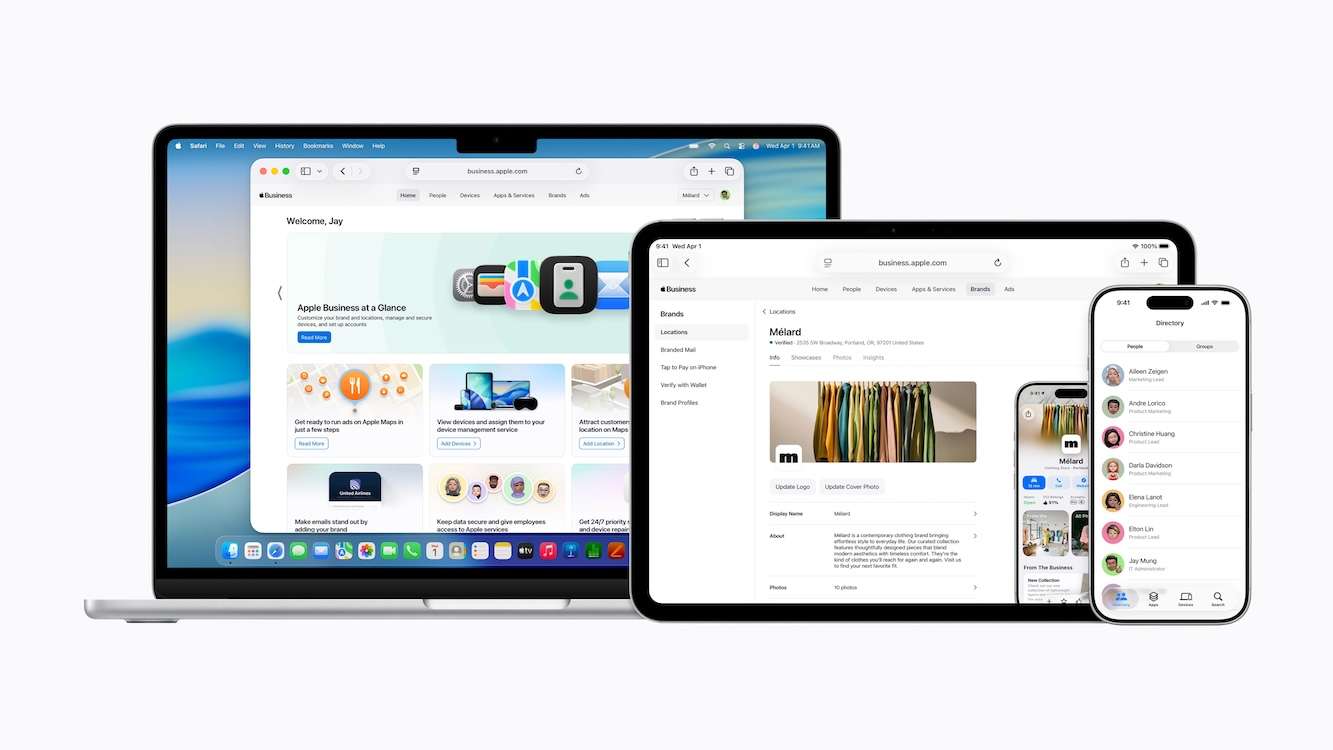
Apple has just pulled the curtain back on its most ambitious enterprise play yet: Apple Business. It isn’t just a rebrand. It is a total unification of Apple Business Manager, Essentials, and Connect into a single, cohesive platform. By integrating device management with professional communication tools, Apple is finally coming for the crown currently held by Microsoft and Google.
The End of Fragmentation
If you have ever managed a fleet of MacBooks or iPads, you know the hidden overhead. Traditionally, you would use Apple Business Manager to buy the devices, a third-party tool to manage them, and then look to Google or Microsoft for your actual mail and calendar. This created a “triple-silo” problem where identity was never truly unified.
The new Apple Business platform changes that math. It introduces fully integrated email, calendar, and directory services with custom domain support. For a creative agency in Singapore or a design firm in London, the ability to jump from a managed Apple account directly into a professional email—all within the native macOS and iOS environment—is a massive friction-reducer. It turns the Mac from a wonderful piece of hardware into a complete business workstation.
Blueprints: The Death of the IT Ticket
One of the most compelling features of this rollout is “Blueprints.” Let’s be honest: not every business has a dedicated IT department. In many creative shops, the “IT person” is just the designer who happens to be the most tech-savvy. Blueprints are designed specifically for these “accidental admins.”
Blueprints allow you to pre-configure device settings, security protocols, and app distributions before a device even leaves the box. When a new hire unboxes their MacBook Air, they simply sign in. The device self-configures, apps appear, mail is synced, and security policies are applied. This is zero-touch deployment that actually feels like zero work. It removes the need for manual setup and ensures that every device in your organization remains consistent and secure.
Identity and Privacy Without Compromise
The biggest headache for Apple-centric businesses has always been the Apple ID. For years, employees used personal accounts for work, or companies created “dummy” accounts that were a nightmare to manage and recover. This led to “shadow IT” and significant security risks.
Apple Business leans heavily into managed Apple accounts to solve these issues. These accounts offer cryptographic separation between work and personal data. This is a win for privacy-conscious organizations. It means your employee can use their favorite iPad for both work and life, but the company’s confidential project files and the employee’s family photos stay in entirely different silos.
Better yet, Apple is playing nice with the incumbents. The platform integrates with identity providers like Google Workspace and Microsoft Entra ID. You do not have to rip and replace your existing identity stack; you can simply layer Apple’s management and productivity tools on top of what you already have.
Made for Creatives
The creative industry has always been Apple’s heartland, yet the administrative side often felt like an afterthought. With Apple Business, the company is providing a professional identity that matches the prestige of the hardware.
The new “Brand Profiles” feature is a perfect example. You can now manage your brand name and logo across the entire Apple ecosystem you operate. This ensures your company name appears correctly in Mail and looks consistent on a client’s iOS device during transactions. For a brand-conscious firm, these seemingly minute details may be the difference between looking like a scrappy freelancer and a world-class firm with finesse.
A Global Ambition?
While some niche features such as ads on Apple Maps are rolling out in North America first, the core of Apple Business will be available globally. Available in over 200 countries and regions, this rollout is a clear signal that Apple wants to be the default choice for the modern workforce everywhere.
The pricing model is equally aggressive. The core service is free for new and existing users of Apple’s business tools. By making the entry point free and offering paid tiers only for extra iCloud storage or premium AppleCare+ support, Apple is removing the last excuse for small businesses to stick with generic, fragmented solutions.
The Verdict: A New Standard?
Is Apple Business going to kill Microsoft Exchange tomorrow? Probably not. Decades of legacy workflows and Microsoft boxes have deeply entrenched large-scale enterprises. However, the tide is changing. With geopolitical shifts worldwide, Apple’s proposition may be easier to digest than others for the new generation of businesses that value design, privacy, and simplicity, as well as those that are emerging and do not have in-house IT teams.
By unifying the device, the OS, the management, and the productivity tools, Apple is providing a comprehensive solution. If your mail is down or your laptop is acting up, you call Apple. April 14 is more than just a software update for the creative sector and the Apple-standardized workplace. It is the moment the Mac finally became a first-class citizen in the business world.
###