


What To Know
- It was a hobby that only a small number of people with a lot of money and time seemed to have the time and money for.
- This device has a smart control system, an auto-tracking mount, and a sophisticated astro camera, all in a body small enough to fit in a jacket pocket.
In high school, my curiosity for the stars outweighed my financial resources. As an amateur astronomer, I wanted to take pictures of the beautiful views in the Messier catalog, but the cost of professional gear, like heavy, motorized equatorial mounts and specialized refractors, was too high. What did I do? Basic, homemade Newtonians made from old lenses and even cardboard tubes. They gave a blurry, short look at the astro-objects, but real astrophotography was still a long way off and costly.
The Annoyances of the Past
For decades, capturing a useful and shared image of deep space proved to be a challenging task. It meant carrying tremendous pieces of equipment to dark places, fighting with tricky polar alignment, dealing with vibration, and stacking hundreds of short exposures on complicated desktop software just to cut down on thermal noise. It wasn’t just the money that made it difficult to get in; it was also the technical challenge. You needed more than just a telescope. You needed a dedicated DSLR, a sturdy tracking mount, a field flattener, guiding cameras, and a degree in post-processing. It was a hobby that only a small number of people with a lot of money and time seemed to have the time and money for.
But now, in the year 2025, everything has changed completely. The DWARF Mini Smart Telescope is making deep-sky imaging more accessible to everyone by being cheap and easy to connect to.
Stargazing on a Computer
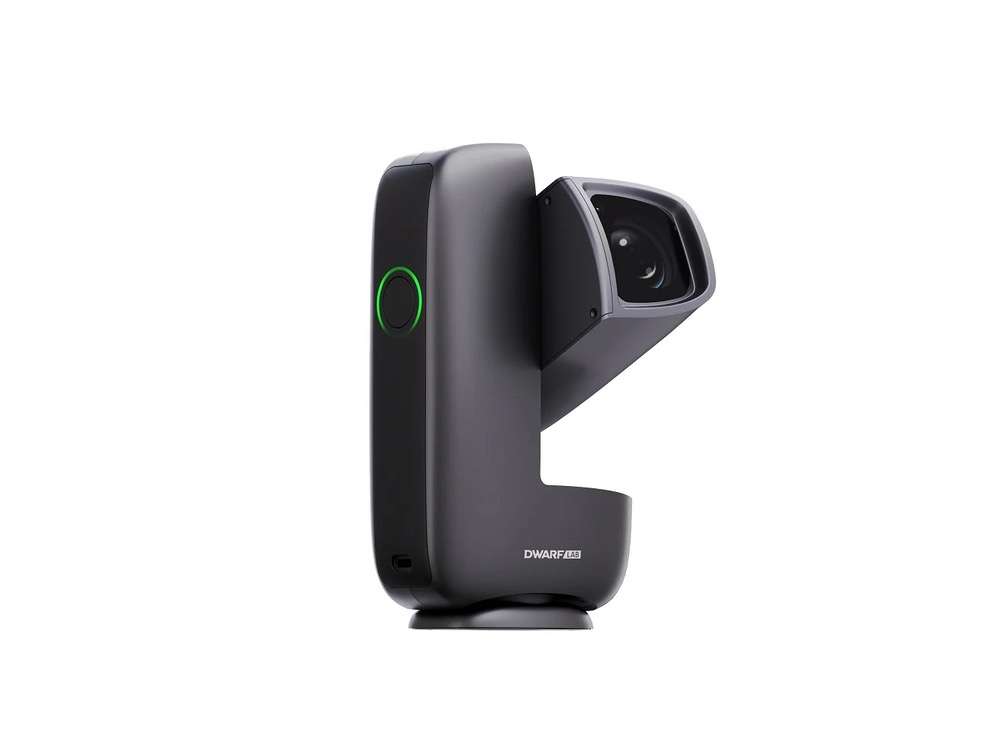
The DWARF Mini is not a telescope in the usual sense. This is not the device for you if you want to look through an eyepiece and see forever. The DWARF Mini, on the other hand, is a highly integrated astrophotography device that was made for a specific purpose. It is a complete change from optics to digital intelligence, which is very empowering for both lifelong astronomy fans and those who are new to the field.
The DWARF Mini is said to be the world’s smallest smart telescope, and at only 840 g, you can really “pocket the universe” with it. Gone are the days of heavy tripods and complicated setups. This device has a smart control system, an auto-tracking mount, and a sophisticated astro camera, all in a body small enough to fit in a jacket pocket. The design philosophy is all about convenience: it takes just three minutes to get from unboxing to taking a picture. The app that comes with the device takes care of all the complicated steps of setup, focusing, and star-hopping using Auto GoTo and precise autofocus.
The imaging system is what makes the DWARF Mini so powerful. With a Sony IMX662 sensor and 2.9 μm pixels, it captures more detail and supports 2MP RAW photography, so the files it creates have all the information needed for high-quality images.
The Art of Accessibility: Taking Pictures of Deep Space
The DWARF Mini really changes the game by making the hardest part of astrophotography easier: stopping Earth’s rotation. When you switch to Equatorial Mode, the smart mount accurately tracks the sky, letting you take longer exposures of up to 90 seconds. This important feature lets you pick up weak deep-sky signals, like nebulosity and galaxies, that you can’t see without long integration times.
The DWARF Mini also solves the problem of light pollution, which is a major issue for stargazers in cities. It has a system of three built-in filters, one of which is a dual narrowband filter that works best for Hα and O III wavelengths. The filter cuts through the moonlight and city glow, making the contrast and detail in nebulae much better, even from a backyard with a lot of light pollution.
But the device’s smartness goes way beyond just taking pictures. To do traditional astrophotography, you need to spend hours on a desktop computer doing complicated post-processing. The DWARF Mini brings that power right to your phone. One-Tap Processing in the app’s Stellar Studio automatically fixes star points, gets rid of noise, and makes nebula details clearer. It even has advanced features for serious users, like Multi-Night MegaStack, which combines exposures from several nights into one stunning, high-data work of art. If you prefer automation, you can set your target and time, allowing the DWARF Mini to shoot while you sleep. When you wake up, you’ll find a clear picture of the Andromeda Galaxy waiting for you in your gallery.
Shareable, Usable, and Social
The last and most exciting part is the focus on sharing. After all, who isn’t sharing on social media platforms these days? The process of documenting the cosmos is now much faster, taking only three seconds from tap to post-worthy image, because the output images can be used and shared right from the device. Astronomy goes from being a solitary activity to a social, connected one thanks to the ability to instantly polish pictures, add custom watermarks, and share accomplishments through “Stellar Badges.” Picture working with other astronomy fans to make a giant mosaic of the Milky Way. The DWARF Mini makes that kind of teamwork possible.
The DWARF Mini doesn’t just sell a product; it sells access to the universe by digitizing and shrinking the most complicated parts of astronomical imaging. Every aspiring stargazer’s childhood dream comes true, demonstrating that the universe is now accessible, affordable, and ready for sharing.
###

Dr Seamus Phan is head of content at Microwire.news (aka microwire.info), a content outreach and amplification platform for news, events, brief product and service reviews, commentaries, and analyses in the relevant industries. Part of McGallen & Bolden Group initiative. Copyrights belong to the respective authors/owners and the service is not responsible for the content presented.